
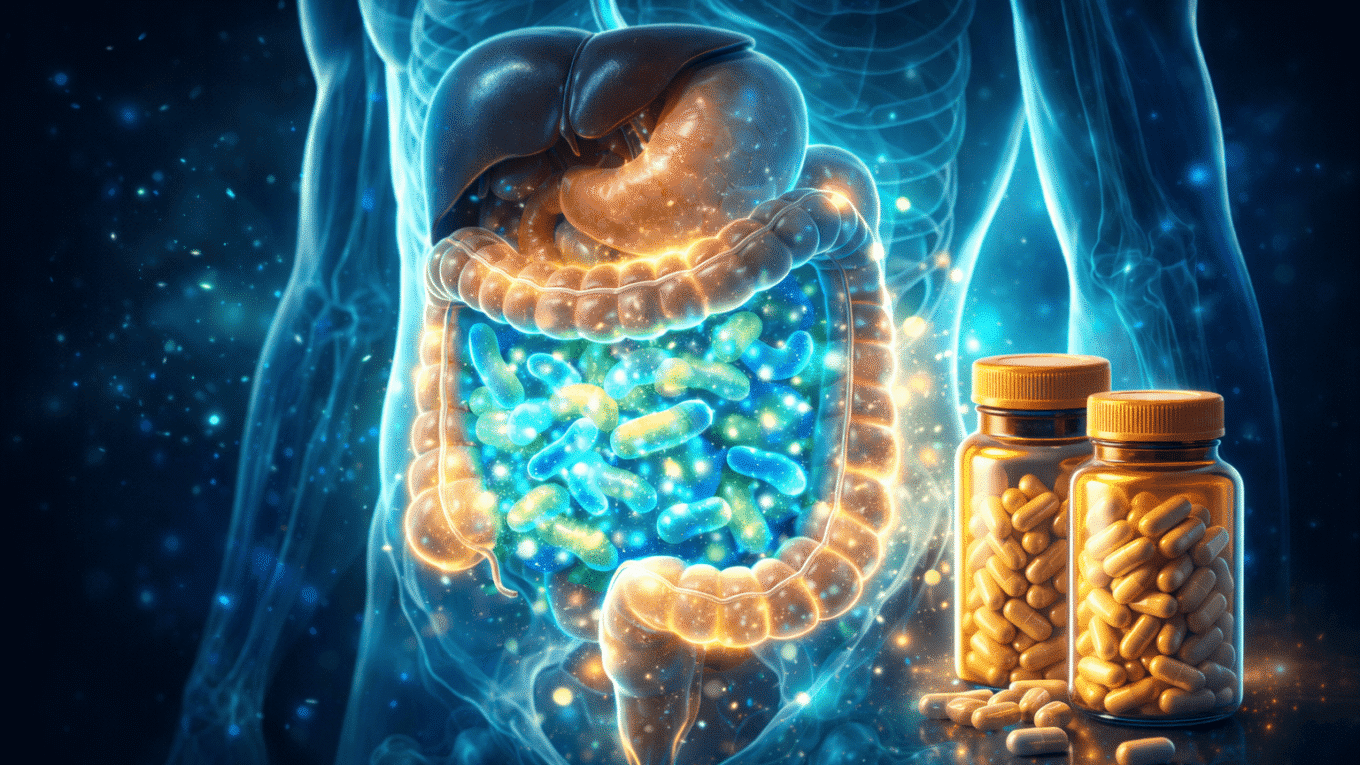
Probiotics for Gut Health: The Best Supplements and Foods to Take
If you’ve been searching for the best probiotics for gut health, you’re right to be skeptical. The supplement aisle is packed with bold promises — yet most people have no idea which strains actually work, which are a waste of money, and whether food might serve them better than a pill.
Walk into any pharmacy and the probiotic section feels overwhelming. Dozens of bottles, billions of CFUs, unfamiliar Latin names. It’s confusing — even for people who already know a fair amount about nutrition.
Fortunately, the science has come a long way. In this guide, you’ll learn which strains have real clinical evidence, the difference between supplements and probiotic foods, and the mistakes most people make when starting out.
What Are Probiotics and Why Does Your Gut Need Them?
Probiotics are live microorganisms — mostly bacteria, sometimes yeast — that provide a measurable health benefit when consumed in adequate amounts. In other words, they’re beneficial microbes you deliberately introduce into your system.
Your gut already contains trillions of these microorganisms. However, poor diet, stress, antibiotics, and age can reduce their diversity and numbers. As a result, your digestive system becomes less resilient — and that’s precisely where probiotics come in.
Think of your gut microbiome like a garden. Probiotics are the seeds you plant to restore what’s been lost. But just like gardening, the right seed for the right soil matters enormously — not every strain does the same job.
That said, probiotics alone aren’t a magic fix. They work best as part of a broader approach that includes a diet built around the best foods for gut health, adequate sleep, and stress management. When those foundations are in place, probiotics can meaningfully accelerate your gut’s recovery and resilience.
The Best Probiotic Supplements for Gut Health
Not all supplements are created equal. In fact, many products contain strains with little to no clinical evidence. Instead of recommending a brand, here’s what the research actually supports — strain by strain.
Lactobacillus rhamnosus GG
This is arguably the most studied probiotic strain in the world. It has strong evidence for reducing antibiotic-associated diarrhea and supporting gut barrier function.
A meta-analysis in Alimentary Pharmacology & Therapeutics found that LGG significantly reduced antibiotic-related diarrhea in both children and adults. (Szajewska & Kolodziej, 2015)
If you’ve recently taken antibiotics or struggle with loose stools, this is the strain to look for first.
Bifidobacterium longum
Bifidobacterium longum is one of the first beneficial strains to decline with age, stress, and poor diet. Research links it to reduced gut inflammation and lower cortisol levels.
A 2019 study in Frontiers in Psychiatry found that B. longum supplementation improved mood and reduced stress markers in healthy volunteers over 4 weeks. (Allen et al., 2019)
It’s especially valuable for people whose gut issues seem connected to anxiety or chronic stress.
Saccharomyces boulardii
Unlike most probiotics, Saccharomyces boulardii is a yeast — not a bacterium. That distinction matters because it survives antibiotic treatment, making it uniquely useful during or after a course of antibiotics.
Additionally, it has strong evidence for preventing traveler’s diarrhea and reducing IBS symptoms. Because it doesn’t compete with bacterial probiotics, it can safely be taken alongside other strains.
Lactobacillus acidophilus
One of the most common strains in commercial yogurts, L. acidophilus supports lactose digestion and helps with general digestive discomfort. While it’s not the most targeted option, it works well as a broad foundation.
Look specifically for “Lactobacillus acidophilus NCFM” — it’s the best-studied version of this strain.
Multi-Strain vs. Single-Strain — Which Is Better?
For specific issues like antibiotic recovery, a targeted single strain performs better. For general microbiome support, however, a multi-strain product covering both Lactobacillus and Bifidobacterium species is more beneficial.
Either way, always check that CFU counts are guaranteed at expiry — not at manufacture — and that capsules are enteric-coated to survive stomach acid.
Best Probiotic Foods for Gut Health
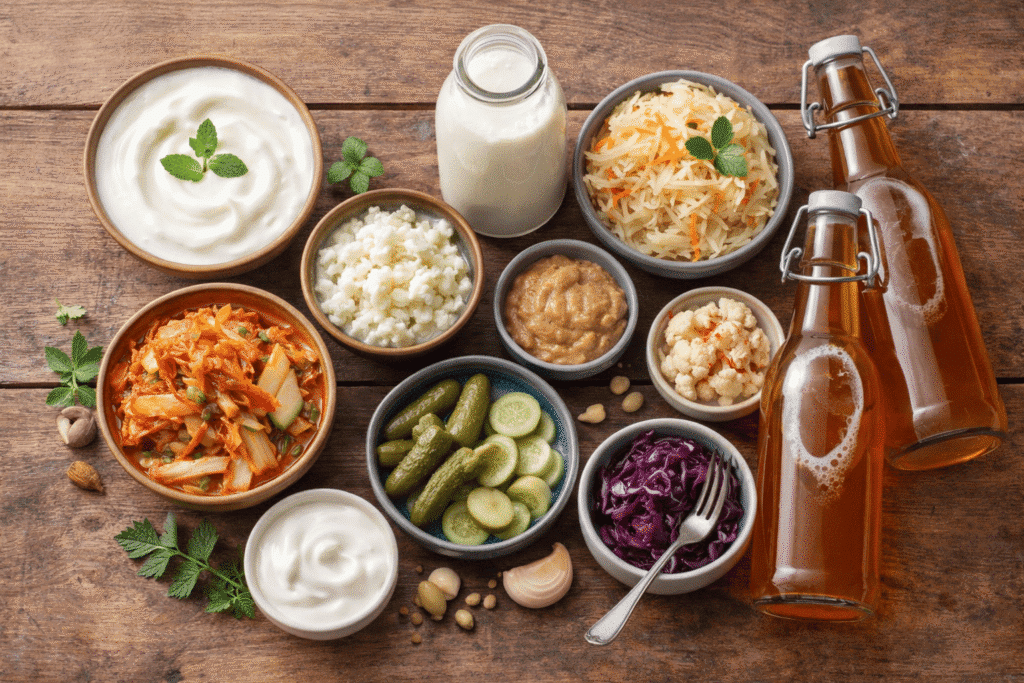
Supplements aren’t the only option. For many people, probiotic foods are more sustainable — and they bring fiber and nutrients that a capsule simply can’t replicate.
• Yogurt — choose plain with “live and active cultures” on the label; avoid flavored versions with added sugar
• Kefir — contains up to 61 microbial species and is often tolerated even by people who are lactose sensitive (Hertzler & Clancy, 2003)
• Kimchi and sauerkraut — just one tablespoon per meal is enough; a Stanford study confirmed fermented foods are among the most effective ways to increase microbiome diversity (Wastyk et al., Cell, 2021)
• Miso — add after cooking, not during, to preserve the live bacteria
• Kombucha — choose raw, unpasteurized versions with less than 5g of sugar per serving
If you’re looking for a broader strategy beyond probiotics, read our complete guide on how to improve gut health naturally for a step-by-step foundation covering diet, sleep, and stress.
Supplements vs. Foods — Which Should You Choose?
The honest answer is that they serve different purposes — and ideally, you’d use both.
Supplements offer precision. When you need a specific strain for a specific problem, a supplement delivers a controlled dose that food can’t match. Probiotic foods, on the other hand, offer diversity and long-term sustainability — especially when you consistently eat the top foods for gut health that nourish beneficial bacteria daily.
In practice, use food as your daily foundation and supplements as targeted support when you have a specific need.
One practical tip: if you’re new to both, start with food first. Add a daily serving of kefir or kimchi for two to three weeks and pay close attention to how your digestion responds. That feedback will tell you a lot about whether your gut needs more targeted support — and if so, which direction to take.
Which Probiotic for Which Problem?
Matching the strain to your issue makes all the difference. Here’s a quick reference:
• Antibiotic recovery → Lactobacillus rhamnosus GG or Saccharomyces boulardii
• IBS symptoms → Bifidobacterium infantis 35624 or Lactobacillus acidophilus NCFM
• Stress-related gut issues → Bifidobacterium longum 1714
• Constipation → Bifidobacterium lactis BB-12
• General support → Multi-strain product with both Lactobacillus and Bifidobacterium
Also, if you haven’t yet identified what’s actively working against your microbiome, check our guide on worst foods for gut health — removing the wrong foods is just as important as adding the right ones.
Common Mistakes When Taking Probiotics
Even with the right strain, people often undermine their results. Here’s what to avoid:
• Taking probiotics with hot drinks — heat kills live bacteria
• Storing supplements incorrectly — many require refrigeration
• Expecting instant results — most studies run 4 to 8 weeks
• Skipping prebiotics — without fiber to feed them, probiotics don’t survive long
• Choosing by CFU count alone — a validated strain at 10 billion beats an unknown one at 50 billion
• Stopping too soon after antibiotics — continue for at least 2 weeks after finishing the course
Frequently Asked Questions
How long before probiotics work?
Most people notice digestive changes within 1 to 2 weeks. However, for more significant issues like antibiotic recovery or IBS, allow 4 to 8 weeks before evaluating results.
Can I take probiotics every day?
Yes — daily consistency matters far more than occasional high doses. Think of it like watering a plant: regular small amounts beat sporadic large ones.
Can probiotics cause side effects?
Mild bloating or gas during the first few days is normal and typically resolves within a week. If symptoms persist beyond two weeks, discontinue and consult a healthcare provider.
Are probiotics safe for everyone?
For most healthy adults, yes. However, people who are immunocompromised or critically ill should consult a doctor first.
The Bottom Line
Navigating probiotics for gut health doesn’t have to be complicated. Match the right strain to your specific need, support it with fermented foods daily, and give your gut the time it needs to respond.
Start with food as your foundation. Then, if you have a specific challenge, add a clinically studied strain that targets it directly. Ultimately, what you do consistently every day matters far more than any short-term protocol.
Your gut is more capable of recovery than most people give it credit for. Give it the right environment — the right foods, the right strains, and a little patience — and it will respond. Small, consistent steps are always what create lasting change.
For a deeper look at lifestyle, diet, and long-term microbiome support, explore our complete guide on how to improve gut health.
Scientific References
Szajewska, H., & Kolodziej, M. (2015). Lactobacillus rhamnosus GG in the prevention of antibiotic-associated diarrhoea. Alimentary Pharmacology & Therapeutics, 42(10), 1149–1157.
Allen, A.P., et al. (2019). Bifidobacterium longum 1714 as a translational psychobiotic. Frontiers in Psychiatry, 10, 231.
Wastyk, H.C., et al. (2021). Gut-microbiota-targeted diets modulate human immune status. Cell, 184(16), 4137–4153.
Hertzler, S.R., & Clancy, S.M. (2003). Kefir improves lactose digestion and tolerance. Journal of the American Dietetic Association, 103(5), 582–587.
Disclaimer: This article is for informational purposes only and does not constitute medical advice. Always consult a qualified healthcare provider before starting any supplement regimen.
2 thoughts on “Probiotics for Gut Health: The Best Supplements and Foods to Take”